STEWARDSHIP · NOT PLATFORM
Should a Pastor Have a Personal Website? A Practical Decision Guide
Not every pastor needs one. Some ministries do.
01
The short answer
The short answer is no. Not every pastor needs a personal website. A pastor does not need another platform simply because websites are available, or because personal branding has become common. There should be a real ministry reason behind creating one.
The conversation changes when a pastor has spent years preaching, teaching, writing, recording podcasts, publishing books, or creating other resources, and there is no clear place where that work can be found.
Sunday after Sunday, pastors preach on specific passages of Scripture, books of the Bible, theological subjects, family, leadership, spiritual growth, and countless other topics. Without intentional organization, much of that teaching becomes another video buried in a church YouTube archive.
The message still exists. The problem is finding it.
That is where a pastor website can become useful. The purpose is not to build up the person. It is to give the teaching a home.
02
A pastor website should organize the ministry, not glorify the pastor
The phrase “personal brand” makes many pastors uncomfortable, and I understand why. If branding means building fame around a minister, creating celebrity, or turning the pastor into the product, I want nothing to do with that.
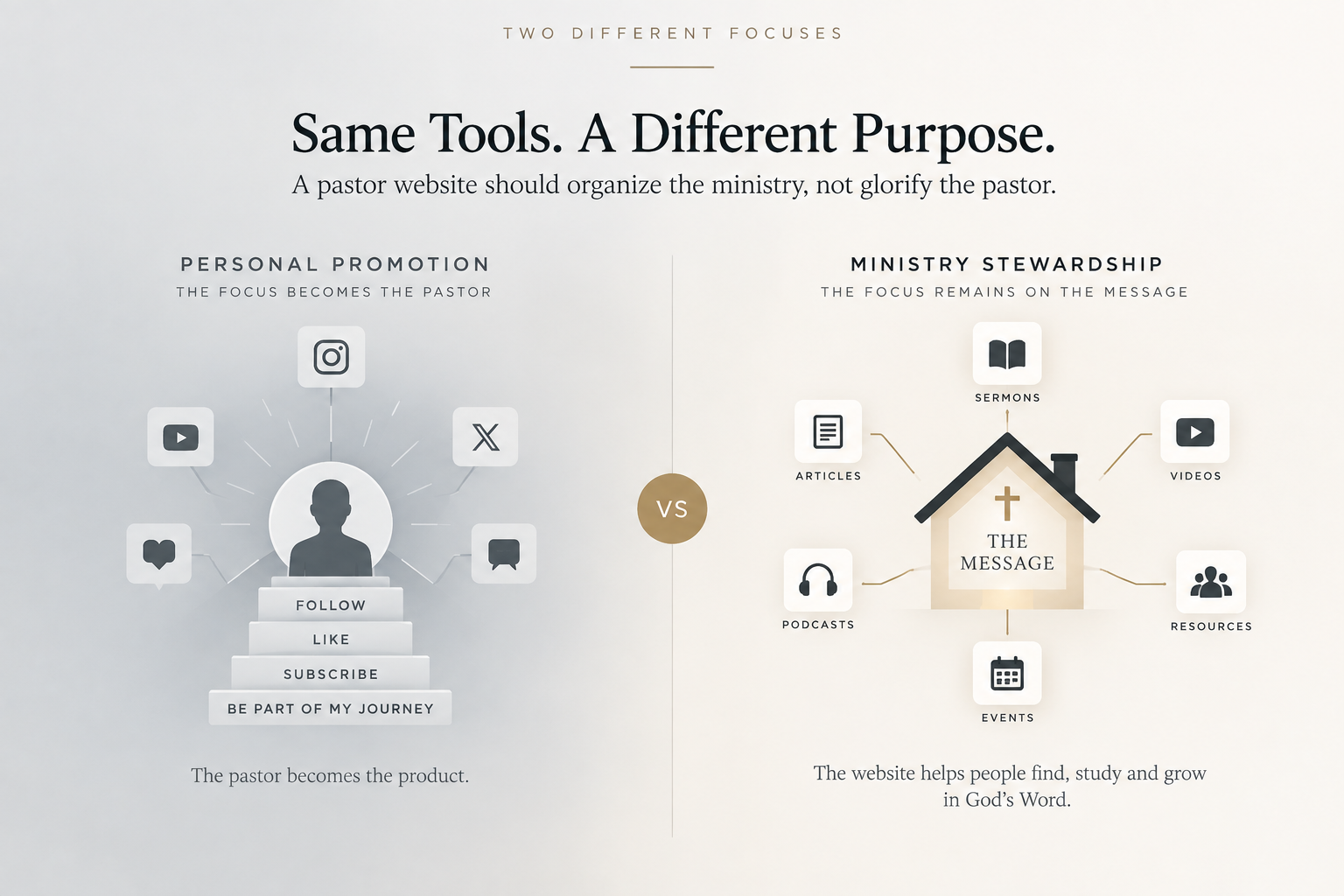
A brand, in the simplest sense, is only the connection people make between one thing and another. In ministry, that connection should never terminate on the pastor. When someone encounters a minister and the work surrounding him, the association should point toward Jesus, Scripture, and truth.
That is the line. If the purpose of a personal ministry platform is attention or self-promotion, the work has crossed into something I am not interested in helping build. But when an identity helps organize years of biblical teaching so someone can find a sermon, study a passage, read an article, or grow in the Word, that is stewardship.
The identity simply helps people recognize and find the message.
03
The problem with letting YouTube become the archive
YouTube is useful for ministry. So are Facebook, Instagram, podcast platforms, and the other places pastors use to distribute teaching. The problem begins when one of those platforms becomes the only real archive for decades of work.
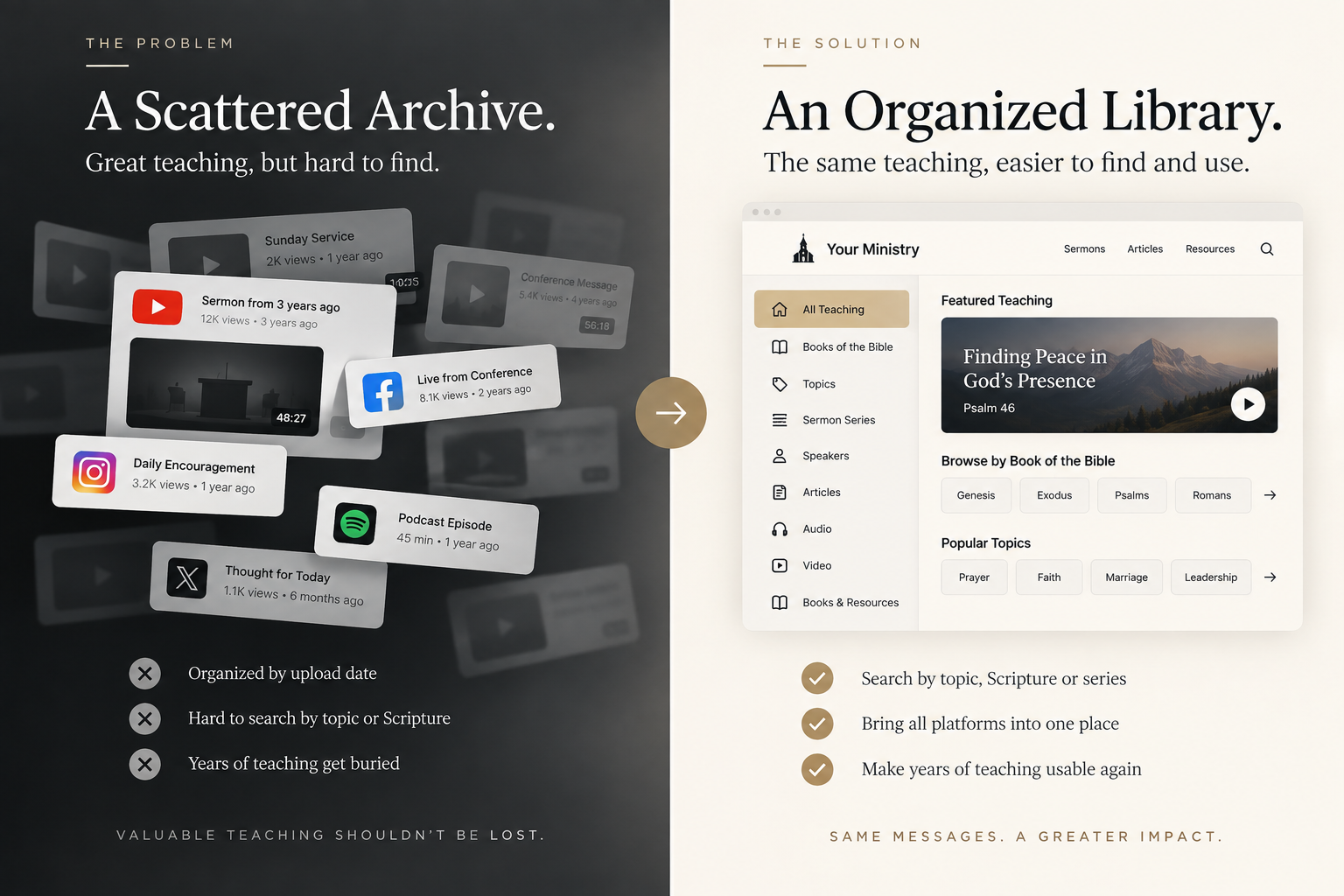
Imagine a pastor who has preached for twenty years. Somewhere in those years may be studies through books of the Bible, messages on marriage and family, teachings on holiness, leadership, conference sermons, Bible studies, articles, podcasts, and other resources. That is an enormous body of work.
Yet in many cases, almost all of it is organized by the date it was uploaded.
Someone may remember a message on a particular subject from five years ago and have no practical way to find it again. They may want everything that pastor has taught from Romans, on prayer, on marriage, or on a specific passage, and there is no simple way to browse the material that way.
There is a difference between having an archive and having a library.
A well-built ministry website can organize those years of teaching the way people actually study: by book of the Bible, Scripture reference, topic, series, question, written resource, audio, and video.
The goal is not merely to preserve content. It is to make the teaching usable again.
04
The website is the house
The easiest way to explain this is to think of the website as the house.
YouTube is one room. Facebook is another. Instagram is another. The podcast is another. Articles, books, sermon resources, and other materials each have their own place as well.
The problem is that someone may discover one room without ever realizing the rest of the house exists.
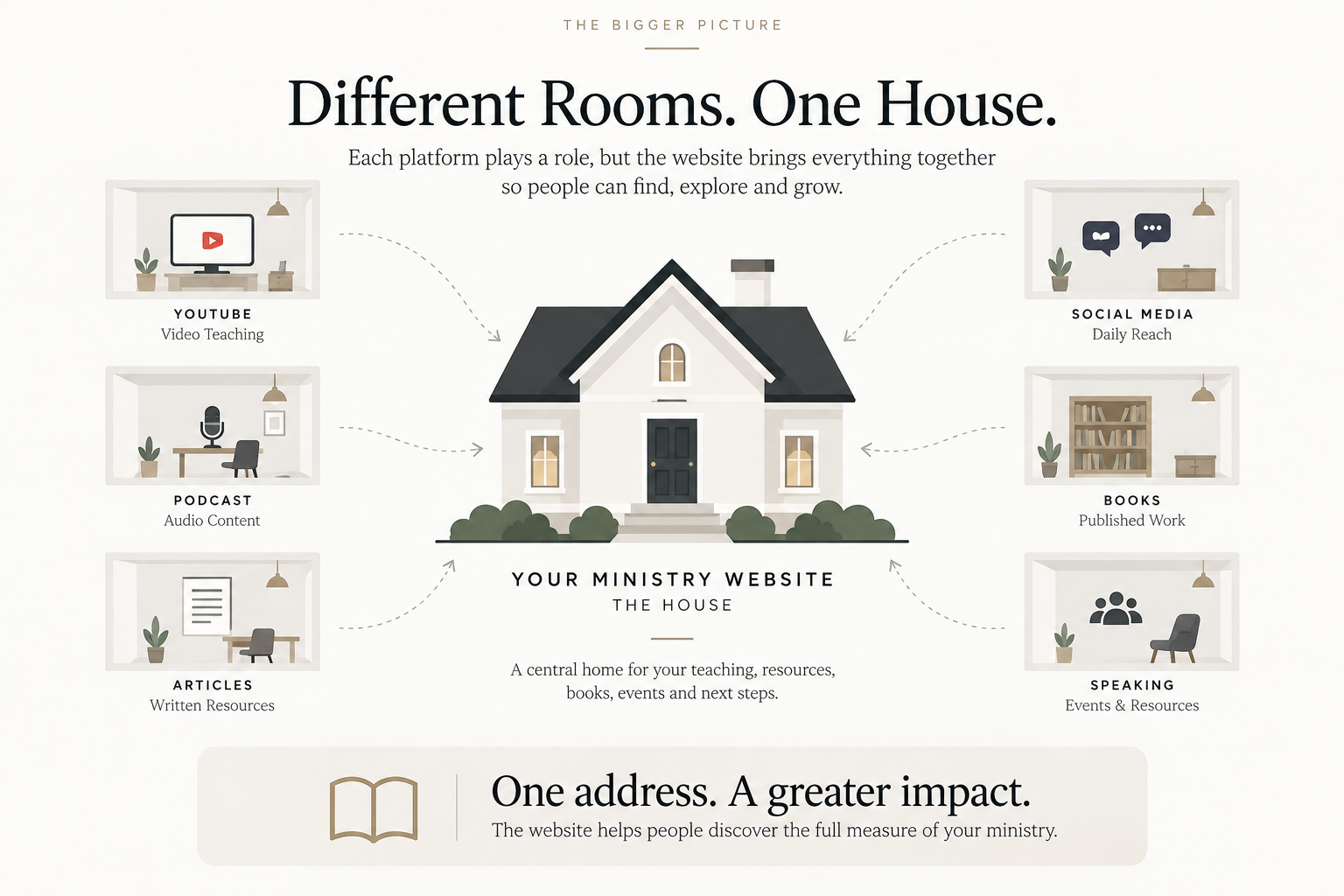
A person may find one sermon on YouTube and never know there are fifteen more messages in the same series. Someone may discover a short video on Facebook and never realize the pastor has written extensively on the same subject. Another person may listen to the podcast without knowing the ministry also has articles, books, or teaching resources.
The website gives all of those things a common address.
It does not replace YouTube, social media, or podcast platforms. Those channels are often where discovery happens. The website is where people go once they want to understand what else the ministry has available.
The social platforms are the rooms. The website is the house.
05
When does a pastor actually need a personal website?
The first thing I look at is the body of work that already exists. A pastor with years of teaching that is scattered, difficult to search, or poorly organized is one of the clearest cases for a separate ministry home.
If there is a substantial sermon archive, books, articles, podcasts, regular video teaching, speaking ministry, Bible studies, courses, or other resources serving people beyond the ordinary life of the local congregation, there may be a legitimate reason to bring those things together.
The reason matters. “I want my own website” is not enough. There should be a ministry problem the website solves.
If people are already asking where they can find old teachings, if resources are spread across several platforms, or if years of material are becoming harder to navigate, a separate website may bring real clarity. My pastor media work is built around that kind of clarity, organization, and stewardship.
06
When I would tell a pastor not to build one
There are also plenty of pastors I would tell not to build a separate site.
If the church already has a strong media presence, a dedicated team, a well-organized sermon archive, and a website where people can easily find the pastor’s teaching, another site may not add anything meaningful. In fact, it could make things worse.
Now there are two sermon libraries, two websites, two places to update information, two identities people need to understand, and another system someone has to maintain. Instead of making the ministry clearer, the new website creates duplication.
If the church is already doing the job well, I would rather strengthen that system through clear church website design than create another platform because a pastor website sounds appealing.
The question should never be, “Can we build another website?”
The better question is, “Would another website make the ministry easier to find, understand, and use?”
If the answer is no, I would not recommend building one.
07
The Steeple & Signal Ministry Home Test
Before I recommend a separate pastor website, there are four things I want to understand.
Is there enough teaching to justify its own home?
A handful of sermons probably does not require another website. Years of preaching, articles, books, podcasts, series, and ministry resources may be a different situation.
Is that teaching actually easy to find?
Being online is not the same as being organized. If someone cannot reasonably find material by topic, Scripture, series, or resource without already knowing the title, there is an organization problem.
Is the church already doing this well?
If the church has a strong website, a capable media team, a searchable sermon library, and a clear system for preserving and distributing the pastor’s teaching, I may recommend keeping everything there.
Would a separate home create clarity or complexity?
This is the most important question. If another website is simply one more platform someone has to maintain, it is probably not worth building. If it brings years of scattered ministry into one organized and understandable place, there may be a strong reason for it.
08
Apostolic Iron is a good example of what I mean
Apostolic Iron is a useful example of when a separate ministry home can make sense.
It was not created because Bishop Chester M. Wright needed a personal brand. It exists because years of teaching had accumulated across different formats and seasons of ministry: individual messages, teaching series, written material, books, video, and other resources that needed more organization than a chronological social feed can provide.
Someone may first encounter that teaching through a Facebook post, a YouTube video, a sermon clip, or another platform. That single piece of content can then lead back to a larger body of work where the teaching is organized and easier to explore.
That is the kind of pastor identity I believe makes sense. The name helps someone recognize the ministry. The website gives the teaching a home. And the teaching should ultimately point beyond the pastor.
09
The goal is not another platform. It is better stewardship.
I do not believe every pastor needs a personal website, and I do not think every ministry needs another brand.
Sometimes the right answer is to improve the church website, organize the existing sermon archive, or strengthen the systems already in place.
But when years of preaching and teaching are scattered across YouTube channels, podcast feeds, social media pages, old posts, books, and disconnected resources, bringing those things together can serve people in a meaningful way.
A pastor may spend decades faithfully preaching the Word of God. My concern is not simply whether those sermons were posted after Sunday.
My concern is whether someone will still be able to find them when they need them five, ten, or twenty years later.
That is where a website can become more than a marketing tool.
It can become the house that keeps the teaching together.